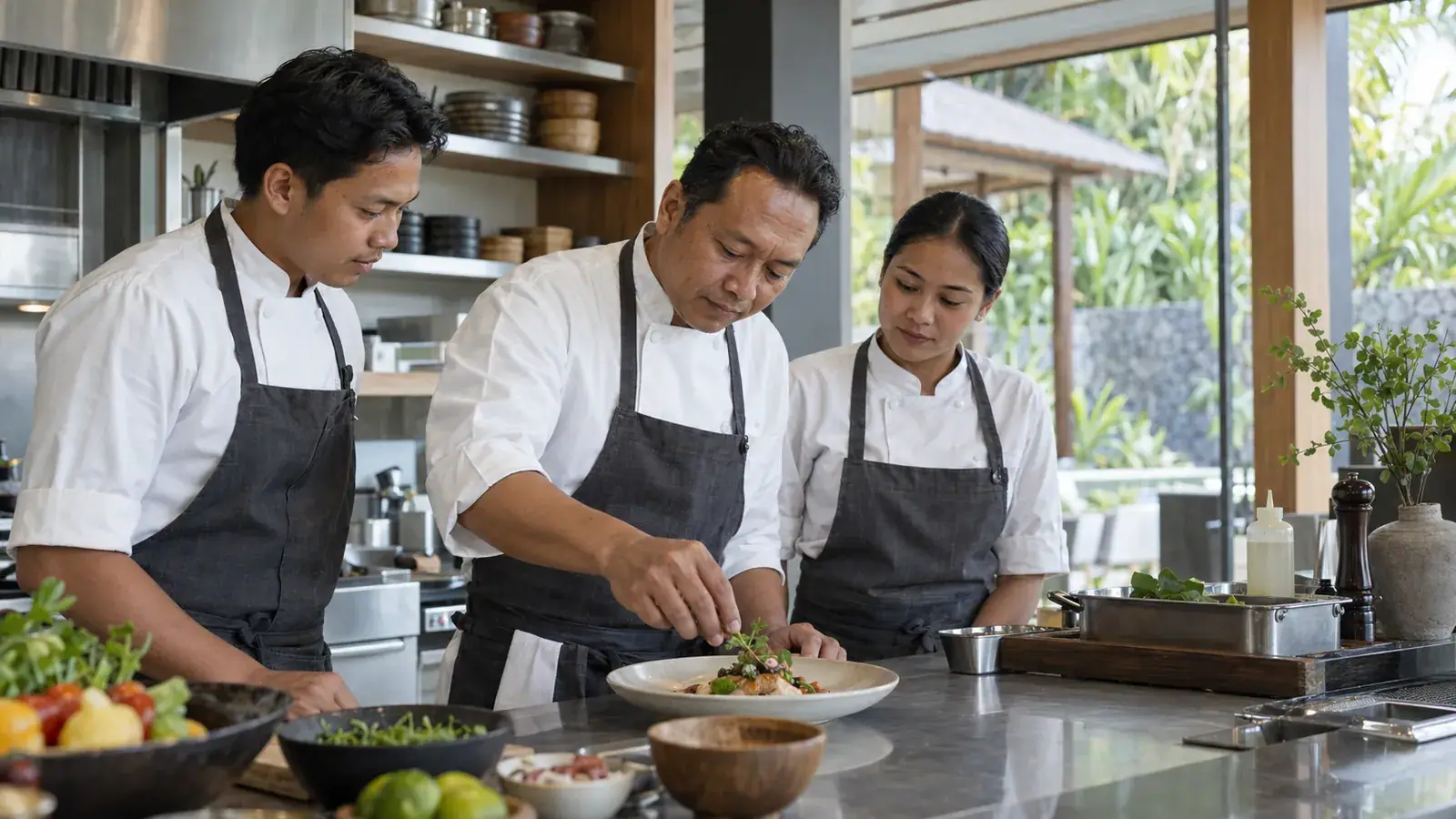
What you will get from this page
Cost one repeatable dish, compare its contribution with the menu mix and check that the kitchen can execute it before launch.
1. Set direction before writing dishes
Define guest, price band, cuisine story, dietary needs, and kitchen constraints. A dish that needs skills or equipment you do not have is a training project or a capital project — not a menu line yet.
2. Taste under time pressure
Approve flavour and plating with the clock running. Beautiful slow plating dies at 70 covers.
3. Standardise and cost
Convert approved dishes into weighted recipes with yield, portion, allergens, and cost per plate. Without this step, “menu development” is only R&D theatre.
4. Train by section and trial
Assign owners, train section by section, then run a full cooking trial. Post-launch accompaniment catches drift after real guests arrive. For hands-on delivery, use our menu development and training service.
Put the guide to work
From a recipe card to a launch decision
Cost one repeatable dish, compare its contribution with the menu mix and check that the kitchen can execute it before launch.
The recipe, purchase costs, selling prices and menu mix below are sample planning figures. They are not myCHEF menu prices or a record of a client menu.
1. Build a recipe-cost card
Example dish: grilled chicken, rice, vegetables and sauce. The quantities below use the listed purchase form, including boneless chicken. When trim or cooking losses affect the required purchase quantity, measure and apply the yield first.
On smaller screens, scroll the table to see every column.
| Ingredient | Quantity | Purchase cost | Cost per portion |
|---|---|---|---|
| Boneless chicken | 160 g | IDR 75,000/kg | IDR 12,000 |
| Dry rice | 90 g | IDR 20,000/kg | IDR 1,800 |
| Prepared vegetables | 120 g | IDR 25,000/kg | IDR 3,000 |
| Prepared sauce | 40 ml | IDR 50,000/litre | IDR 2,000 |
| Oil and seasonings | Recipe allocation | Costed per batch | IDR 1,200 |
| Total ingredients | Not applicable | Not applicable | IDR 20,000 |
At a sample net selling price of IDR 80,000, ingredients are 25% of sales and contribution before labour, overhead and other costs is IDR 60,000. Record recipe version, supplier cost date, batch yield and a plating reference with the card.
2. Read the menu as a group
Compare similar items in the same menu category. Here, contribution means selling price less ingredients only. Relative popularity comes from the venue’s own sales mix, not a universal target.
On smaller screens, scroll the table to see every column.
| Dish | Net price / ingredients | Contribution | Observed mix and action |
|---|---|---|---|
| Grilled chicken plate | IDR 80,000 / 20,000 | IDR 60,000 | High popularity: protect consistency and availability. |
| Vegetable bowl | IDR 75,000 / 17,000 | IDR 58,000 | Low popularity: test description or placement. |
| Beef sandwich | IDR 85,000 / 34,000 | IDR 51,000 | High popularity: review purchase yield and recipe. |
| Premium seafood special | IDR 110,000 / 58,000 | IDR 52,000 | Low popularity: review demand, waste and station load. |
- Compare preparation time, waste and equipment demand alongside contribution. Ingredient cost alone does not establish profitability.
- Test one change at a time so you can tell whether a new recipe, price or description affected sales.
3. Use a launch checklist
- Recipe and costing
Confirm portion weights, batch yield, current costs and the approved selling price.
- Service rehearsal
Cook the proposed mix together and record ticket times, plating and station load.
- Team briefing
Confirm the recipe, ingredient information, substitutions and service description.
- Review date
Set a date to review sales, waste, guest feedback and preparation time after launch.
Your next step
Cost and rehearse a small group of dishes first. Launch only once the same recipe, portion and description can be repeated by the team.
Related commercial service
Menu Development and Training
Menu strategy, costing, recipe standardisation, tasting, plateware, section training, cooking trials, and post-launch accompaniment.
FAQ
Quick answers
Short clarifications so you can decide the next step faster.
Still deciding?
Send your date, guest count and villa area — we reply within 1 hour with a fixed quote.