Family-style dinner vs buffet: which works in a villa?
Shared platters or a buffet line for a villa group: a fair decision table, who should choose each, and what the comparison leaves out.

A villa group can eat well in two different ways. Family-style means shared platters on the table you are already sitting at. The kitchen sends dishes out, people pass them, and the meal has a start and a finish. A buffet means a staffed line or station. Guests leave the table, serve themselves during a window, and the food is held ready while photos, speeches or late arrivals happen. Neither format is the polite version of the other. They suit different headcounts, different clocks and different rooms.
This page is that decision for a Bali villa. It is not a price list, not a children's menu, and not a plated-versus-buffet argument. Menu floors stay on the commercial pages: how villa dinners are styled for shared and seated meals, and buffet menus and guest minimums when the line is the product. One celebration sitting is catering. A full day of cooking across several meals is a different booking, on the stay-chef page.
What each format actually is
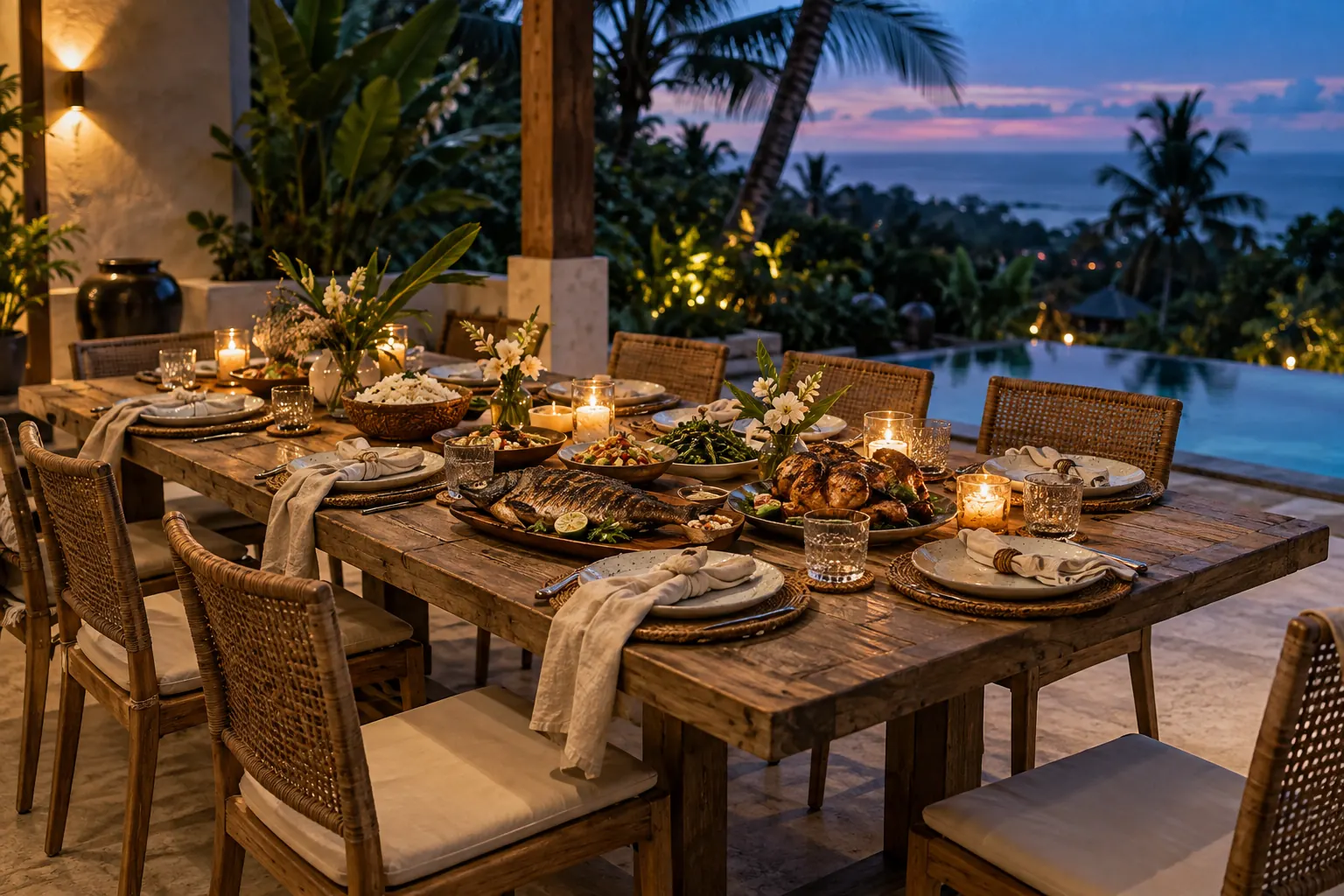
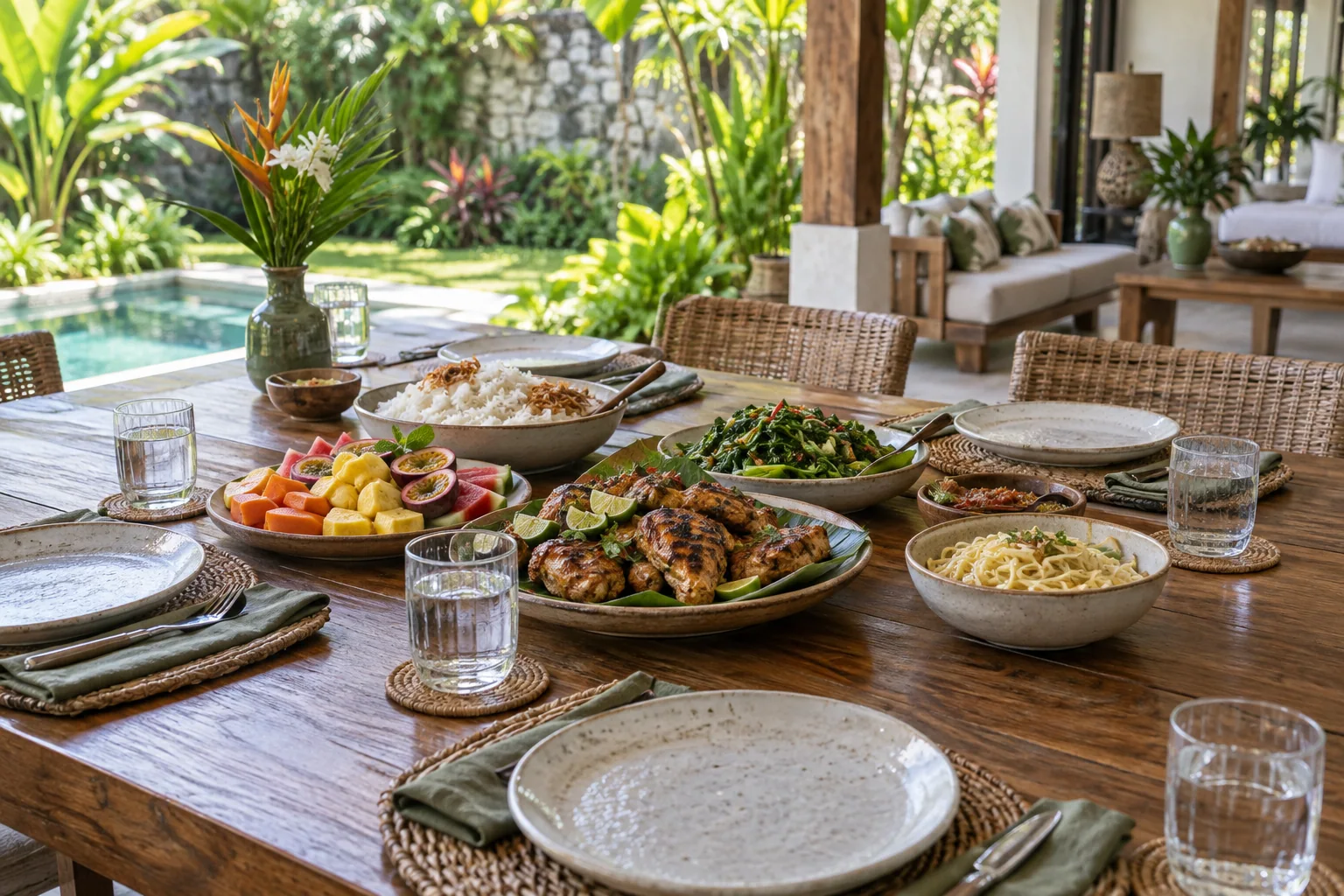
Family-style here is a way of serving, not a cuisine and not a kids' menu. Several dishes land in the middle of the table at once, or in a short sequence of shared courses. Portions are planned for the group. Someone refills a platter when it empties. Guests do not queue. The table is the restaurant.
A buffet is a small production line inside the villa. Chafing dishes or stations, labels, a path for guests, and a person whose job is the line rather than the conversation. People eat at different moments inside a service window. Plates still need clearing, or the dining table becomes a second, messier buffet.
A third format sits outside this comparison: a plated dinner, one composed plate per person, course by course. If that is the real question, use buffet or plated service. This page stays on shared platters versus a line.
Decision table
Read each row as a tendency, then check it against the villa you have booked. A huge terrace can host a line that a narrow dining room cannot. A table for ten can feel generous with platters and cramped if everyone stands up to serve themselves.
| Question | Family-style platters usually fit | A buffet usually fits |
|---|---|---|
| How many people eat? | One table, often under 20 | A larger crowd. Buffet bands start higher; smaller groups are often better on platters or plated plates |
| One shared moment? | Yes. Sit, start, finish together | No. Waves of arrivals, or children eating first |
| The room | A table everyone can reach across | Space for a line that does not block the kitchen |
| How guests choose | A menu agreed in advance | Each person builds a plate |
| Dietary splits | A separate platter, its own spoon | Labels and a gap so the restricted dish stays apart |
| Children | A plain platter within reach | Older children who can walk a line. Toddlers still need a made plate |
| Staff | Refill and clear at the table | Someone on the line for the whole window, plus clearing |
| Leftovers | Easier to plan from food just out of the kitchen | Hot-held food is not automatically tomorrow's lunch |
| Where the detail lives | Seated and shared villa styling | Buffet menus and minimums |
Who should choose family-style
Choose shared platters when the evening is the table itself.
- The group fits one table and you want them to stay there.
- You would rather approve a menu in advance than watch people build uneven plates.
- A toast or a birthday speech needs a single moment, not a queue.
- The dining room is the handsome part of the villa, and the terrace is too narrow or too windy for a line of chafing dishes.
- You are under the headcount where a buffet stops making sense. The buffet page says that below its standard minimum, sharing or plated service usually works better. Confirm the live number there.
Family-style is a weaker fit when half the group is still in the pool at 7pm, children need to eat at 6, and everyone else wants 8. A platter does not wait for an hour without drying out. If the evening is a moving party, a line with a real window is the more honest format. What a shared table looks like in practice lives on how those dinners are styled.
Who should choose a buffet
Choose a buffet when variety and timing matter more than one seated moment.
- The guest count has left "one table passing bowls" behind. Villa parties, retreats and receptions are the usual case.
- Tastes genuinely diverge, and you would rather people assembled a plate than negotiate one menu.
- Arrivals are staggered: airport runs, a photoshoot, or children who must eat before the adults sit down.
- You have a wall or terrace long enough for a line that does not block the kitchen door.
A buffet is a weaker fit for eight people at a beautiful table who pictured platters, not a queue in their own house. It is also the wrong tool if the villa has already forbidden the tables, the route or the hours you need, and you have not asked the manager. Formats and minimums stay on the buffet page. If this meal is one night inside a longer stay, the wider context is villa catering.
What this comparison excludes
- Plated service. One plate per person, in courses, is a different product. Compare it with a buffet on buffet versus plated, not here.
- What children should eat, by age. That guide is family dining and children's menus. This page only asks which service format survives children in the room. It will not repeat that guide.
- A full-day stay versus one catering night. Several meals, with groceries at cost, are not the same purchase as one platter dinner or one buffet. Use stay chef or catering.
- Prices. Floors change by format and guest band. Read them on the pages linked above and on pricing. This article will not invent a per-person winner.
- Which coast to stay on, and full wedding production. Area choice and a wedding timeline have their own pages. A reception can need a buffet and still need a planner.
Children and two sittings
The usual failure is the clock, not the cuisine. Adults want 7:30pm and the children were done at 6. Family-style can be two passes of one menu: an earlier plain plate, then the full platters. The kitchen needs that split before shopping, and the children need somewhere to go afterwards.
A buffet fits staggered eating. Open when the children are hungry; adults serve themselves later. You pay for hot-holding and a longer team, not a neat 90 minutes. Toddlers still need a plate made for them, and the dishes need to sit where a small child is not underneath them.
Dietary needs at one table
Platters fail when someone cannot share the spoon. A nut allergy, coeliac disease or a strict brief is not "pick around it" once a dish has been crossed. Use a separate labelled platter, set down first, and say so before shopping.
A buffet lets people choose, and it fails if every spoon is shared. Ask for labels, a separate utensil and a gap for the restricted dish. If the room cannot hold that gap, stay with platters. A surprise restriction on the night is a different menu, especially once food is in chafing dishes.
Service staffing
Once the group is more than a tiny table, someone has to watch empty platters, empty glasses and cold children's plates. That is not the cook's only job. If the quote is silent on the floor, ask who refills and clears, and for how many hours.
A line does not run itself either. Food has to be replenished, and plates have to leave the table during service. A four-hour party is not a 90-minute dinner. The quote should show the hours. One event is catering. A full day of staff, with groceries at cost, is the other model. Buy the one you need.
Leftovers and the fridge
Lunch-from-dinner is easier with platters you planned to reheat or eat cold, if they have not sat out through a long speech. Hot-held buffet food is not the same. Ask what will be chilled and what will be discarded. Many villa fridges fit a couple, not a reception. Paying for the food does not make a tired tray safe at midnight.
Timing, heat and the villa clock
Platters need a start time people will meet. If they go down for a half-empty table, they wait in warm air. Allow a short grace, then begin. A shared dinner that starts an hour late is how groups talk themselves into a buffet.
A buffet needs a window and a line ready before the first hungry child. Outdoor lines need a rain plan. Wind cools food. Indoor lines must not block the kitchen. A long platter meal in a stuffy room, or a line on an unshaded terrace at midday, fails for the same reason: the room cannot support the format at that hour.
FAQ
Is family-style the same as a children's menu?
No. It is shared platters. What to cook for children, by age, is the other guide linked above.
Can a small group still have a buffet?
Under the usual minimum it mostly adds a queue. Ask for platters unless you have a reason for self-service.
Which is cheaper?
Only with the same guest count, hours and inclusions. Use pricing, then compare written quotes.
Can we mix both?
Platters plus one assembly station is a hybrid. Say so in the brief, or the staffing will not match the meal.
Where to go next
- How shared and seated villa dinners are styled
- Buffet menus, minimums and inclusions
- Villa catering if this meal sits inside a longer stay
- Stay chef or catering if you are choosing a booking model, not a serving format
- How to compare catering quotes once two proposals are in hand
When you enquire, say the headcount, whether you need one moment or a window, and whether anyone cannot share a serving spoon. That is enough to be pointed at platters or a buffet before anyone talks about a deposit. A written quote is not a booking until the deposit that confirms the date has been received.