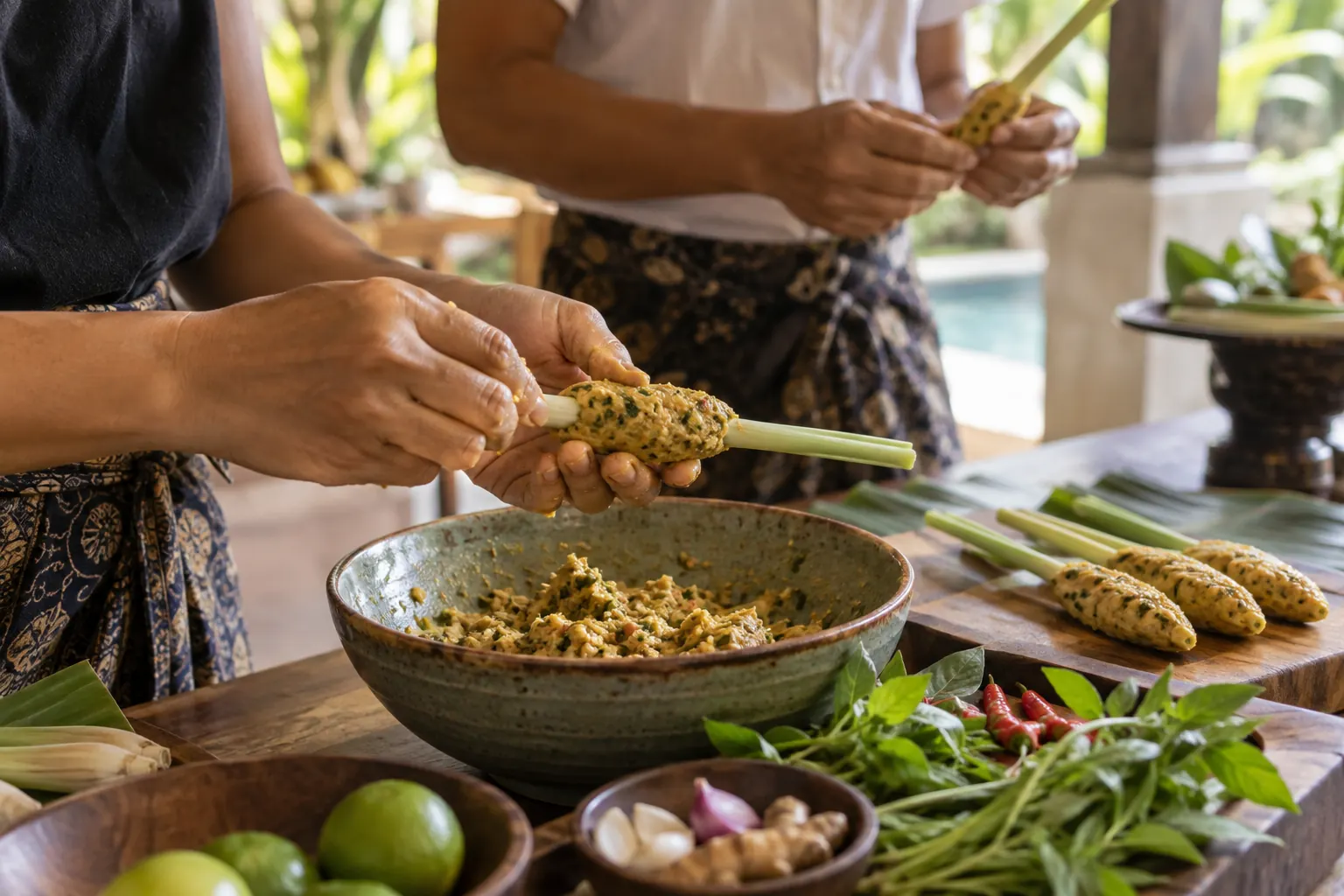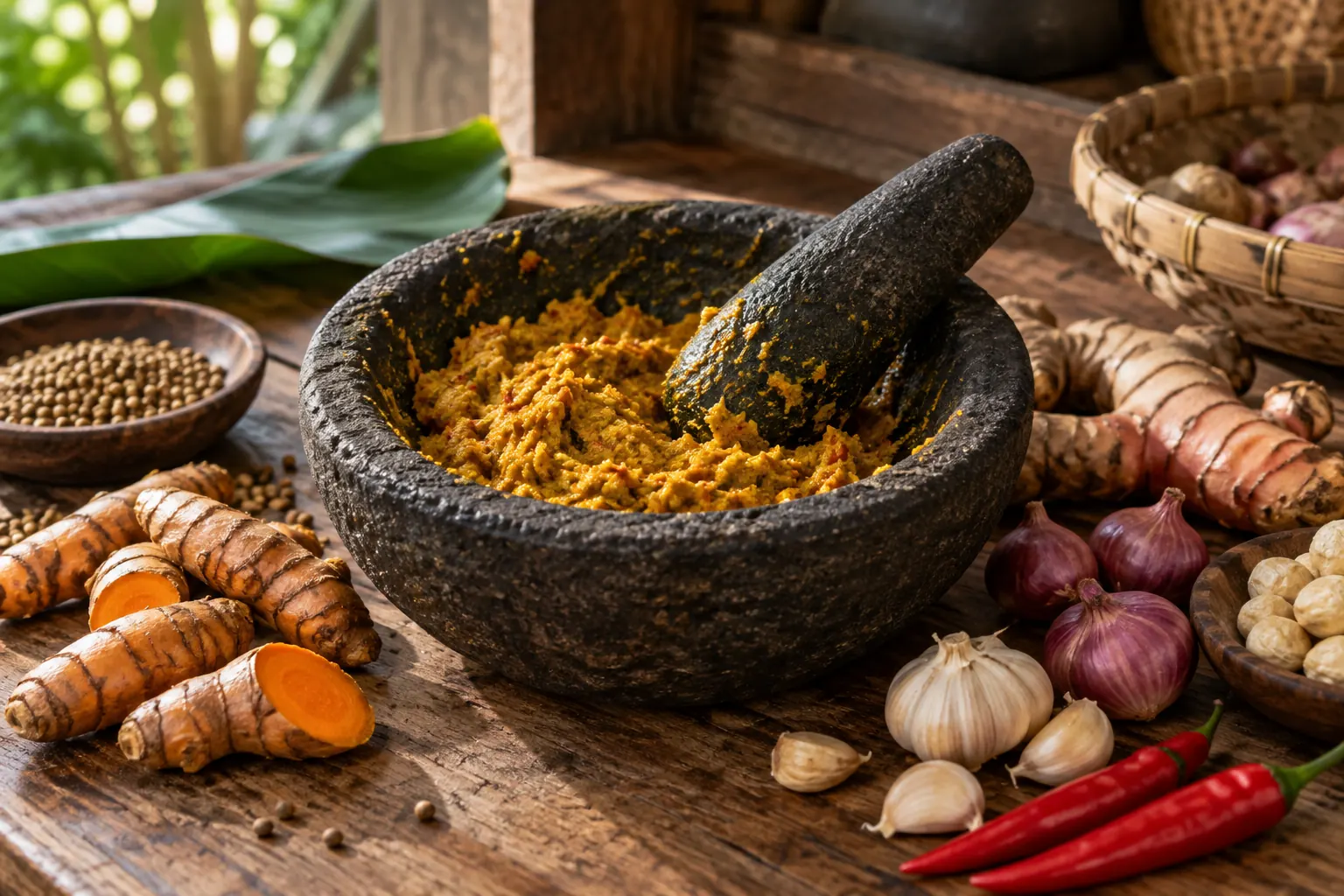
If there is one thing to understand about Balinese cooking before you ever pick up a knife, it is base genep — the "complete spice paste" that sits beneath almost every savoury dish on the island. Learn base genep and you have not learned a recipe; you have learned the grammar of a cuisine. This is the paste our chefs build by hand in every private cooking class, and the one thing guests message us about long after they have flown home.
What is base genep?
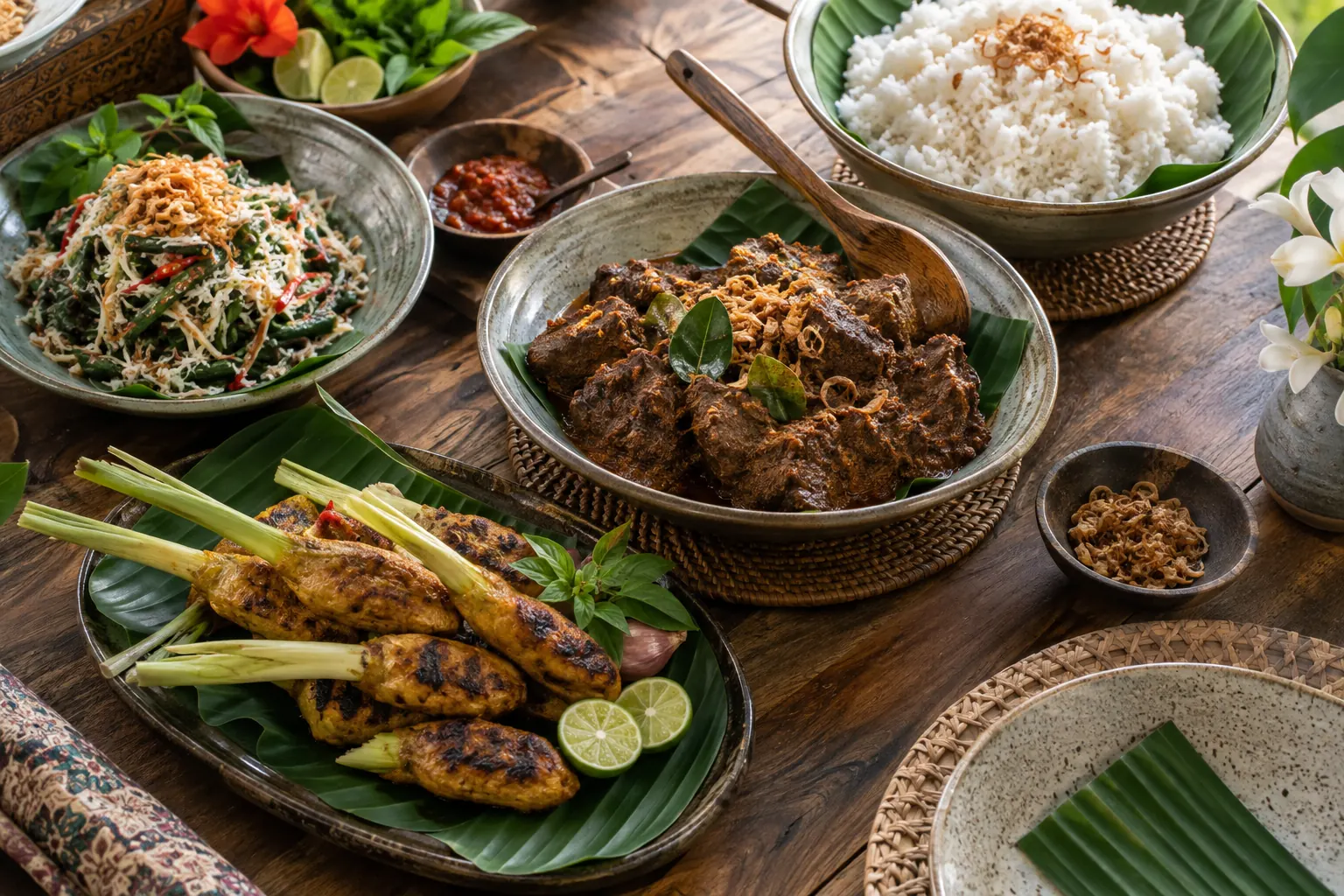
Base genep (also written base gede, and known more broadly as bumbu Bali) means, roughly, "complete seasoning." It is a wet spice paste of around fifteen fresh aromatics, ground together and gently fried until the raw edge cooks off and the kitchen fills with a smell that is unmistakably Balinese. Where a Thai curry leans on its paste and an Indian dish on its garam masala, Balinese food leans on base genep. It goes into betutu, into lawar, into soups, sautés, grilled fish and vegetable dishes — the same foundation, seasoned and stretched a hundred ways.
The ingredients
Exact ratios are a matter of family and region — every Balinese grandmother swears by hers — but a working base genep contains most of the following:
- Shallots and garlic — the sweet, savoury base.
- Galangal (lengkuas), ginger and turmeric (kunyit) — the three rhizomes that give the paste its colour, warmth and earthiness.
- Kencur (aromatic ginger, sometimes called sand ginger) — the note most people cannot place; camphorous and distinctly Balinese.
- Candlenut (kemiri) — ground to thicken and enrich, a little like a savoury macadamia.
- Lemongrass, coriander seed and bird's-eye chilli (cabai rawit) — fragrance, brightness and heat.
- Terasi (toasted shrimp paste) and palm sugar (gula merah) — the umami depth and the sweetness that balances it.
- Finishing aromatics such as salam leaves and kaffir lime leaves.
Coconut oil binds it as it fries. That is a long list for one paste — which is precisely the point. The depth does not come from any single ingredient; it comes from the balance between all of them.
Sad rasa: the six-flavour idea
Balinese cooks talk about sad rasa — six tastes a good dish should hold in tension: sweet, sour, salty, bitter, spicy and astringent. Base genep is where that balance is set. Too much chilli and it bites; too much palm sugar and it cloys; the terasi must be present but never announce itself. A cook who understands sad rasa can taste a paste and know exactly what it needs — and that instinct, far more than any written recipe, is what a good class hands you.
How it is made — cobek, ulekan and the finger measure
Traditionally, base genep is pounded, not blitzed. The tool is the cobek and ulekan — a heavy stone mortar and pestle — and the method matters: pounding (ulek) crushes the cells and releases oils in a way a blender's blade does not, while some aromatics are finely chopped (rajang) rather than pulverised. Many cooks measure by takaran jari, the "finger ratio" — a pinch, a knuckle, a thumb-length of this or that — instead of by scale. A blender works perfectly well at home, and we will show you how to adapt; but pounding a paste by hand even once teaches you what the finished texture should feel like.
Using base genep at home
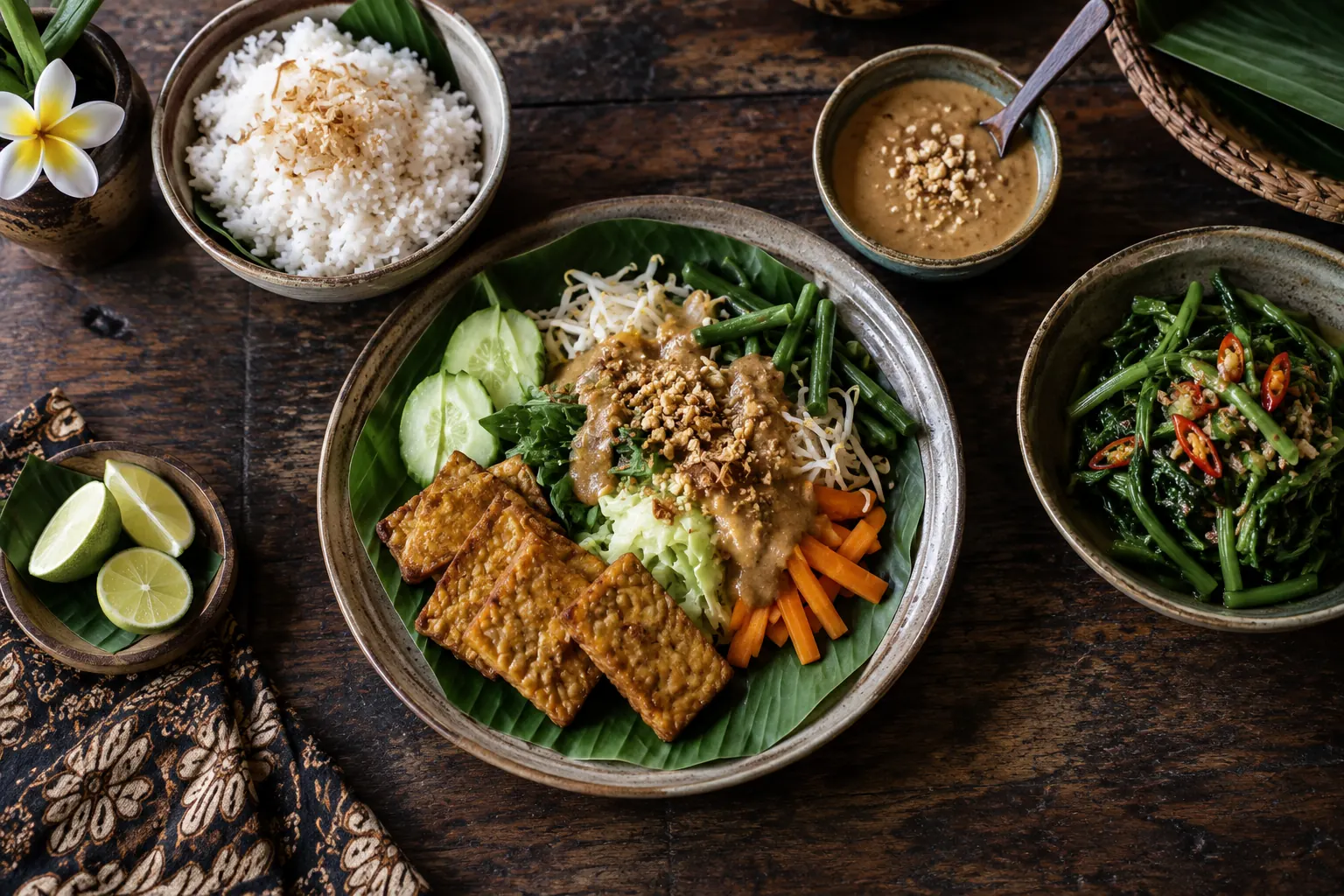
The quiet genius of base genep is that it keeps. Make a large batch, fry it off, and store it in the fridge under a film of oil for a week, or freeze it in portions. After that, dinner is fast: a spoonful of paste into hot oil, add protein or vegetables, a splash of water or coconut milk, and you have the base of a Balinese meal in minutes. This is exactly what the recipe cards from your cooking class are built around — restaurant flavour, home-kitchen logistics. Leave out the terasi and the same paste is fully plant-based — the foundation of a vegan Balinese menu.
Where base genep sits in the bigger picture
Base genep is also the clearest example of what separates Balinese food from the pan-Indonesian dishes most travellers know. Nasi goreng does not need it; betutu and lawar are unthinkable without it. If that distinction interests you, read why Balinese food is not Indonesian food.
Learn to build it yourself
The best way to understand base genep is to make it — to smell the raw paste, then smell it again after it fries, and taste the difference. In a private myCHEF cooking class you pound your own base genep in your villa kitchen, cook a full Balinese menu around it, and eat everything you make. From IDR 700,000 per person (minimum 4 guests). Message us on WhatsApp with your villa area and dates, and we will send a sample menu.