myCHEF — bali catering menu
Bali Catering Menus
By myCHEF Team
Traditional, Seasonal & Modern Cuisine for Your Villa
- Seasonal Sourcing
- Traditional Balinese
- Fusion & Modern
- Dietary Options
Published rates are ++ — 10% service charge and 11% government tax are added to the listed price. Your quote is always confirmed as a fixed, itemised all-in total before you commit.
Bali Catering
Bali Catering Menus: Traditional, Seasonal & Modern Options for Your Villa
Balinese cuisine is a complex blend of spices, fresh herbs, and cooking techniques developed over centuries. Eating traditionally in Bali is an immersion into island identity — food carries cultural meaning, ritual, and a flavor depth rarely found in fusion interpretations.
Whether you prefer traditional Balinese, modern fusion, or international cuisine, this guide covers menu styles, Bali's seasonal ingredients, dietary accommodations, occasion-specific planning, and how to choose the right approach for your event. Visit our catering hub for full service options, or browse pricing details before you plan. For more menu inspiration, try Indonesian street food at your villa or festive season menu planning.
Seasonal Sourcing
Bali's Seasonal Ingredients: What's Fresh and When
Bali's equatorial climate produces exceptional year-round growing conditions, but the island has distinct wet and dry seasons that affect what's best on the plate. Our chefs source daily from Ubud market, Badung central market, Jimbaran fish market, and direct farm relationships in Kintamani, Bedugul, and Jatiluwih — the key to menus that taste genuinely Balinese rather than imported.
Dry Season (April–October) — Peak Growing Season
The highlands around Bedugul and Kintamani produce their best yields during the long dry months. Expect: sweet highland tomatoes, bell peppers, chillies, corn, cabbage, broccoli, cauliflower, strawberries (Baturiti farms), local mushrooms, and robust lemongrass. Fish is plentiful off the south coast, with tuna, mahi-mahi, and snapper landed fresh at Jimbaran daily. Dry season is the ideal window for whole-fish BBQ, corn-fed chicken, and vegetable-heavy Balinese ceremonial menus.
Wet Season (November–March) — Tropical Harvest
Rain triggers lush growth in lowland areas. Wet season brings: young coconuts, papayas, bananas, jackfruit, rambutan, mangosteens, starfruit, and Bali's prized salak (snake fruit). Rice paddies are green and flooded — new-harvest rice in January and February is noticeably sweeter. Wet season is the chef's preferred time for coconut-milk curries, fruit-forward desserts, and slow-cooked dishes that match Bali's occasional cool highland evenings.
Year-Round Staples
Balinese cooking relies on a core of aromatics that grow year-round: turmeric, galangal, ginger, lemongrass, kaffir lime, shallots, garlic, candlenut, and fresh chilies. These form the base of almost every sauce, marinade, and spice paste (base genep) used in traditional cooking. Our chefs blend these fresh daily rather than using pre-made pastes — the difference is immediately noticeable in depth and freshness of flavor.
Highland vs. Coastal Sourcing
A meal in Canggu draws very different produce from a meal in Ubud. Canggu villas are close to coastal fish markets; Ubud area properties sit near Kintamani's highland farms. Our chefs plan sourcing routes around your villa location to minimize transport time and maximize freshness. In Bedugul or Munduk, the farm is sometimes 15 minutes away.
Traditional Cuisine
Balinese Traditional: Iconic Dishes & Flavors
Traditional Balinese cooking is ceremonial food adapted for daily life. Many of the most celebrated dishes were originally prepared for temple offerings, cremation ceremonies, and harvest festivals. That heritage gives them a complexity that rewards slow preparation — not shortcuts.
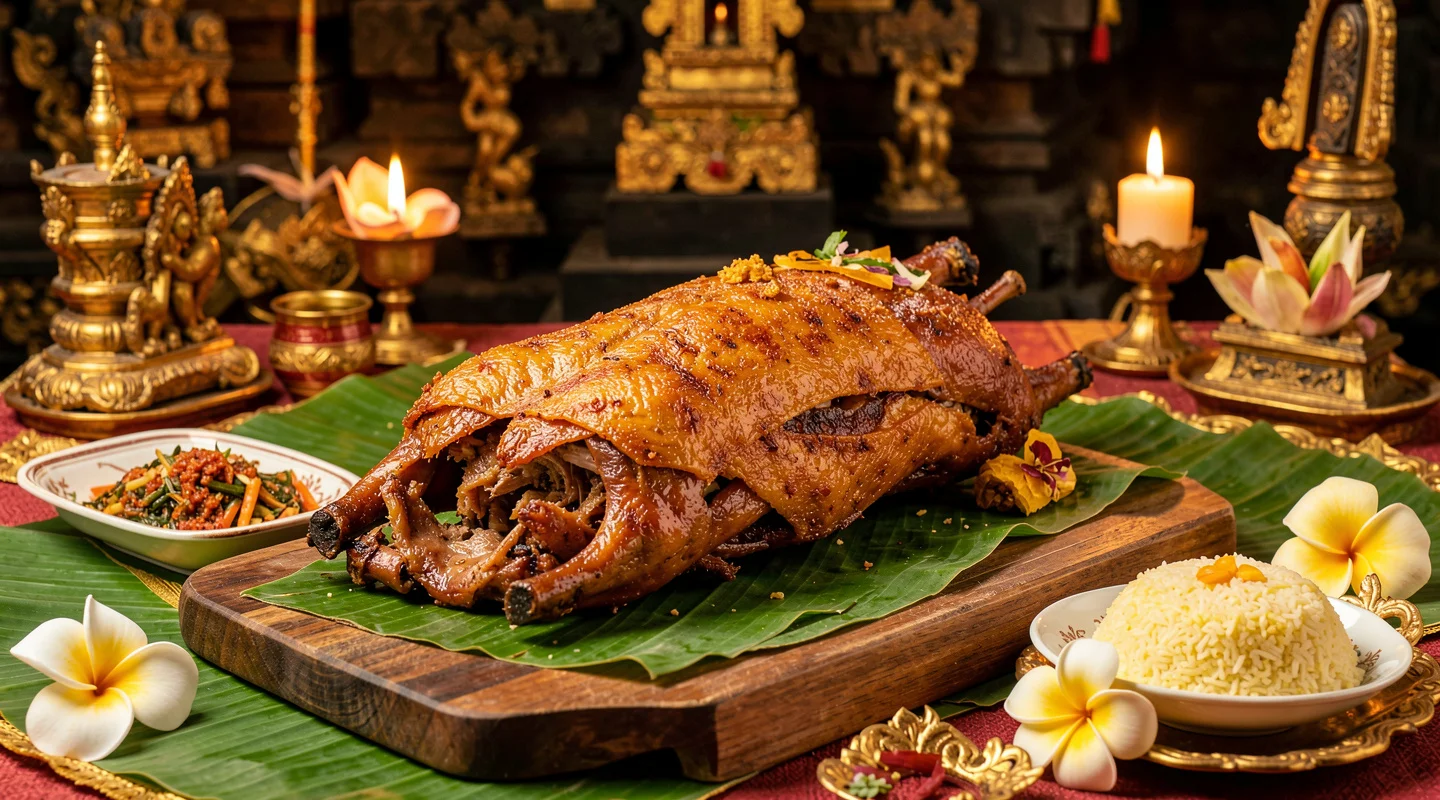
Babi Guling (Roasted Suckling Pig): Whole young pig seasoned with a base genep spice paste of turmeric, coriander, galangal, and garlic, then roasted over coconut-wood charcoal for 4–6 hours. The skin blisters into crackling. Served with rice, lawar, and sambal matah. Famous in Gianyar and Ubud — our chefs source the pig from traditional Balinese farms that free-range feed. Best for groups of 8+.
Sate Lilit (Minced Meat Satay): Ground fish, chicken, or pork mixed with grated coconut, galangal, shallots, and kaffir lime, then moulded onto thick lemongrass stalks and grilled over charcoal. The lemongrass infuses smoke and citrus into the meat as it cooks. Served as a starter or alongside rice.
Lawar (Minced Meat Salad): Finely chopped raw or cooked meat (pork, chicken, or jackfruit for vegetarians) mixed with grated coconut, spices, fresh blood (traditional), and raw vegetables. A ritual dish for ceremonies — the blood binds the ingredients and adds earthy depth. A vegetarian lawar substitutes jack fruit or young coconut.
Ayam Betutu (Slow-Smoked Chicken): Whole chicken stuffed with spice paste and wrapped in banana leaves, then smoked over smoldering coconut husks for 6–8 hours. The result is intensely fragrant, fall-off-the-bone tender. Traditionally prepared for cremation ceremonies. One of the most labour-intensive dishes in Balinese cooking.
Rijsttafel (Indonesian Rice Table): 12–20 small dishes served around a central bowl of fragrant rice — curries, salads, grilled items, sambals, pickles, and crackers. Guests assemble their own plates, sampling a range of flavors in a single sitting. Dutch-colonial in origin, now fully Balinese in execution. The ideal format for groups that enjoy variety and sharing.
Dietary Options
Dietary Accommodations: Vegetarian, Vegan, Gluten-Free & Allergen-Safe
Bali is one of the world's most accommodating destinations for dietary requirements — the local cuisine is rice-based (naturally gluten-free), uses minimal dairy, and has a rich tradition of vegetable cooking in temple food. Our chefs handle dietary restrictions as a standard part of every menu briefing, not an afterthought.
Vegetarian: Balinese vegetarian cooking is genuinely diverse — gado-gado, cap cay, pepes tahu (banana-leaf wrapped tofu), tempeh manis, and the full spectrum of vegetable sambals. International vegetarian includes pasta, risotto, grilled halloumi, and frittata. Same pricing as omnivore menus for standard vegetarian. Protein from legumes, tofu, tempeh, eggs, and dairy.
Vegan: Plant-based Balinese with sambal vegetables, turmeric curries in coconut milk or coconut cream (naturally vegan), grilled jackfruit as a meat substitute, and Balinese black rice pudding with coconut for dessert. Cashew cream replaces dairy in Western dishes. Premium: +IDR 150,000–300,000/person for specialty sourcing.
Gluten-Free: Balinese cooking is naturally largely gluten-free (rice-based staples, no wheat flour in traditional dishes). Watch points: kecap manis (sweet soy sauce) contains wheat — we substitute tamari or coconut aminos. Rice noodles replace pasta; polenta or potato replace bread-based elements. Minimal extra cost for most menus.
Keto / Low-Carb: Substitute cauliflower rice or skip rice entirely. Protein-heavy Balinese (babi guling, ayam betutu, fish satay) naturally suits keto. Standard pricing or lower.
Allergen-Safe (Nut, Shellfish, Dairy): Requires advance notice at booking. Nut-free Balinese is achievable (replace candlenut with sunflower seed in spice pastes). Shellfish-free menus exclude shrimp paste (terasi) and replace with vegetable-based umami alternatives. Dairy-free is standard in most Balinese dishes. Premium: +IDR 300,000–600,000/person for specialty sourcing and dedicated prep equipment.
Share all dietary requirements at booking — not after. Last-minute changes limit sourcing options and can compromise safety.
Selection Guide
How to Choose the Right Menu for Your Event
Group Size & Composition: 2 people → fine dining, intimate tasting menu. 4–6 → balanced between interactive and elegant plated. 8+ → buffet or grazing for easier logistics and dietary split management.
Cuisine Preferences: Adventurous guests who want to experience Bali → Balinese traditional or contemporary Balinese fusion. Guests who travel frequently and prefer familiar flavors → international or farm-to-table. Families with children → hybrid buffet with Balinese and Western options side by side.
Dietary Restrictions: The more complex your dietary mix, the more a buffet format helps — separate dishes allow each guest to self-select. For plated menus with multiple dietary tracks, brief the chef at booking with all requirements.
Occasion: Anniversary or honeymoon → fine dining, plated tasting menu with wine or cocktail pairings. Family reunion → Sunday rijsttafel buffet or babi guling feast. Corporate team dinner → multi-stream buffet with full service. Yoga retreat → wellness menu, plant-forward, light portions.
Venue & Setting: Outdoor pool terrace + Bali weather risk (afternoon squalls Nov–Feb) → lighter grazing or buffet that tolerates brief delays. Covered indoor villa → any format works. Beachside (Jimbaran, Ketewel, Cepaka) → BBQ or sunset grazing board with fresh seafood.
Budget Per Person — see our full pricing page and cost breakdown:
- IDR 750,000–1,200,000/person → casual, local ingredients, buffet or BBQ style
- IDR 1,200,000–1,800,000/person → mix of local and imported, some creative plating
- IDR 1,800,000+/person → fine dining, specialty chefs, imported proteins, wine pairing
Ready to Plan
Design a Custom Catering Menu for Your Villa Event
Questions
Frequently Asked
Still deciding?
Send your date, guest count and villa area — we reply within 1 hour with a fixed quote.
Still deciding?
Send your date, guest count and villa area — we reply within 1 hour with a fixed quote.
Still deciding?
Send your date, guest count and villa area — we reply within 1 hour with a fixed quote.
Explore More
Private Chef Ubud
Best market sourcing and traditional Balinese menus.
Private Chef Canggu
Contemporary and fusion menus for lifestyle villas.
Fine Dining Guide
Premium tasting menus and wine pairings in Bali.
Pricing & Packages
Full pricing for private chef and catering services.
Private Chef Cost Bali
Detailed cost breakdown for every budget level.
Food Allergies Guide
Managing dietary restrictions with a private chef.
Event Planning Bali
Full logistics guide for villa events.
Ready to Get Started?
Tell us your group, occasion, and dietary needs — we build a seasonal menu around Bali's freshest produce.
Published rates are ++ — 10% service charge and 11% government tax are added to the listed price. Your quote is always confirmed as a fixed, itemised all-in total before you commit.