How Milan Fine-Dining Training Shapes Our Villa Cooking
How Milan-trained Italian technique shapes private chef dining in Bali — sauces, plating, and five-star villa service. Read the myCHEF journal.
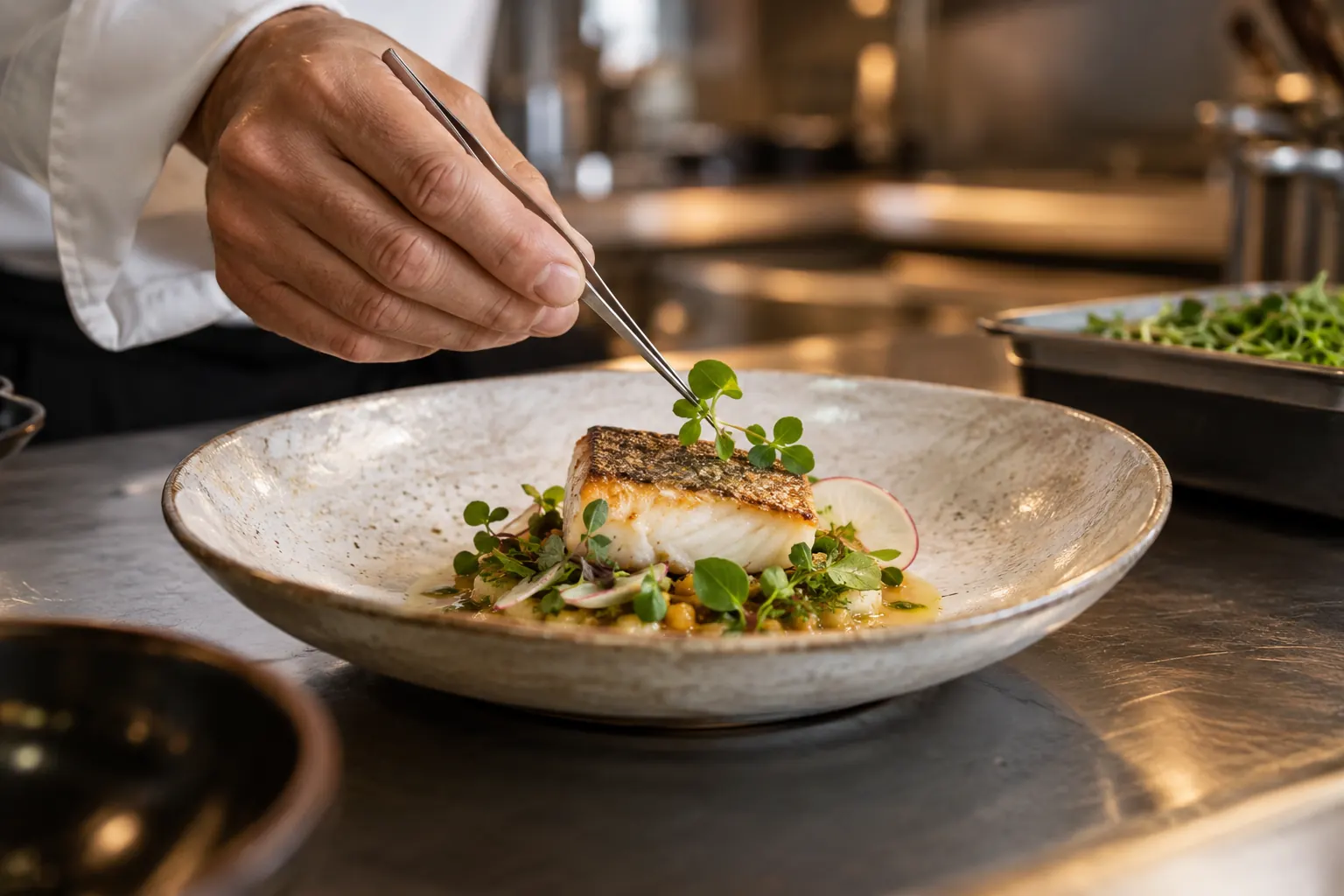
Guests often ask what “Michelin training” means when dinner is served at a villa table, not under a restaurant canopy of stars. The honest answer is not a plaque on the wall. It is a way of working: temperature discipline, sauce control, plating restraint and service timing learned under pressure — then adapted to an open kitchen three metres from the guest.
myCHEF was founded by Adriano, who is fine-dining trained in Milan. That background shapes how we hire, how we brief menus and how we run service in Bali villas. It does not mean the company holds Michelin stars. Stars belong to restaurants that earn them; what travels is technique and standard.
This article explains what that training changes in practice — pasta, sauces, plating and service — and how it shows up when you book a tasting dinner, romantic evening or multi-course villa meal through our fine dining and private chef programmes.
What Milan fine-dining training actually teaches
A serious kitchen in Milan does not romanticise chaos. It trains repetition until quality becomes the default under load. You learn:
- How to hold precision when tickets stack
- How to season for balance, not for Instagram salt crusts
- How to build sauces that coat rather than flood
- How to plate with intention so every element earns its place
- How to communicate without drama on a pass
Those habits matter more in a villa than people expect. There is no large brigade hiding mistakes. There is no walk-in full of prepped insurance. The guest can see the board, smell the pan and notice if timing slips. Technique either holds or it does not.
From restaurant pass to villa kitchen
Translating restaurant training to Bali is not about recreating a Milan dining room under a thatched roof. It is about extracting what is essential:
- Mise en place as non-negotiable — board organised, off-cuts cleared, tools returned
- Temperature as a skill — rest times, carryover cooking, hot plates for hot food
- Seasonality as a constraint — menus follow what is excellent now, not what a PDF promised six months ago
- Service choreography — courses timed to conversation, not to a kitchen’s convenience alone
Local ingredients make the translation better, not weaker. Deep-yolk eggs from Tabanan, herbs from highland farms, fish landed the same morning — technique has more to work with when produce is honest. That sourcing philosophy sits in our sustainable sourcing guide.
Plating: restraint that still feels generous
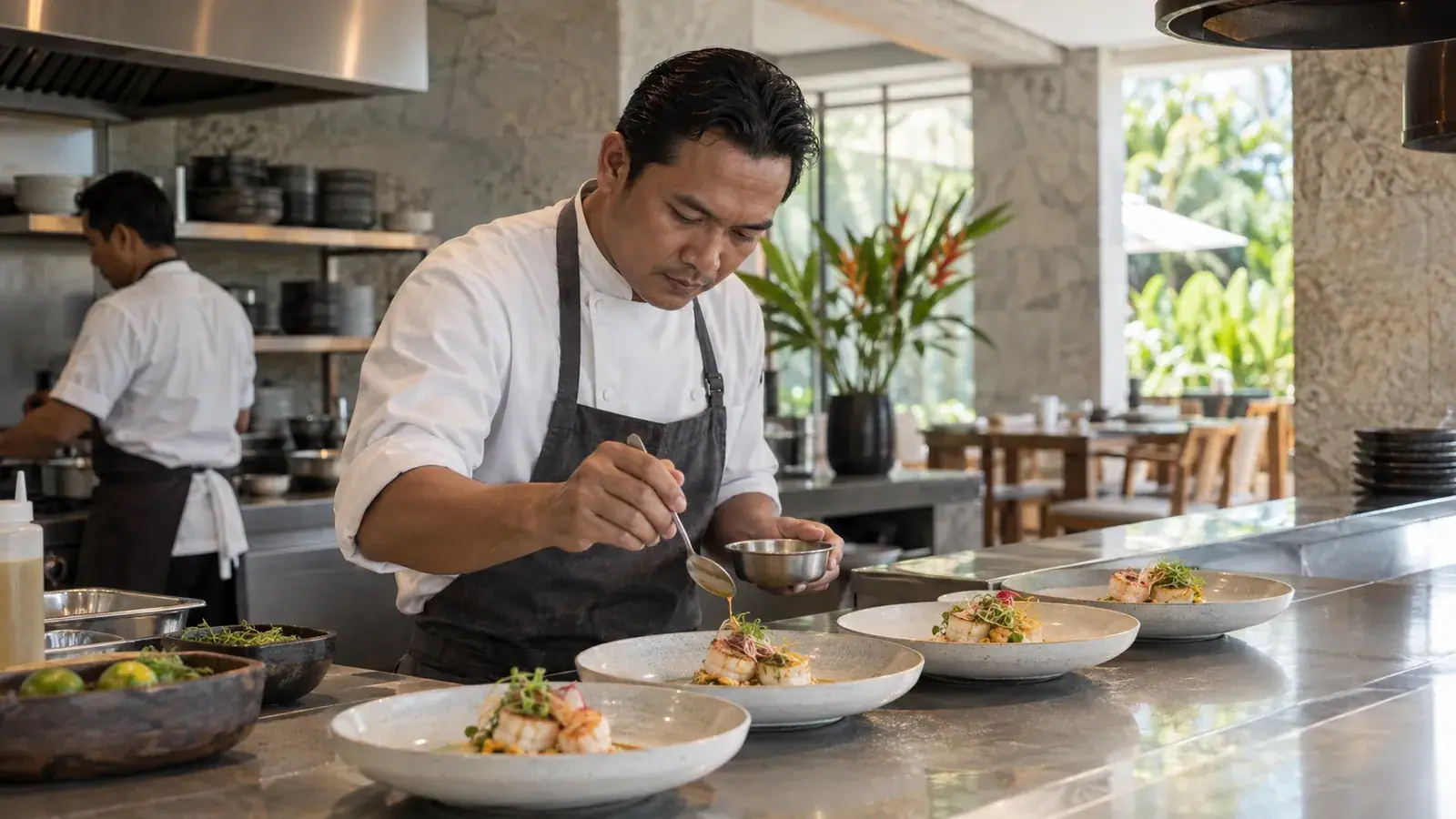
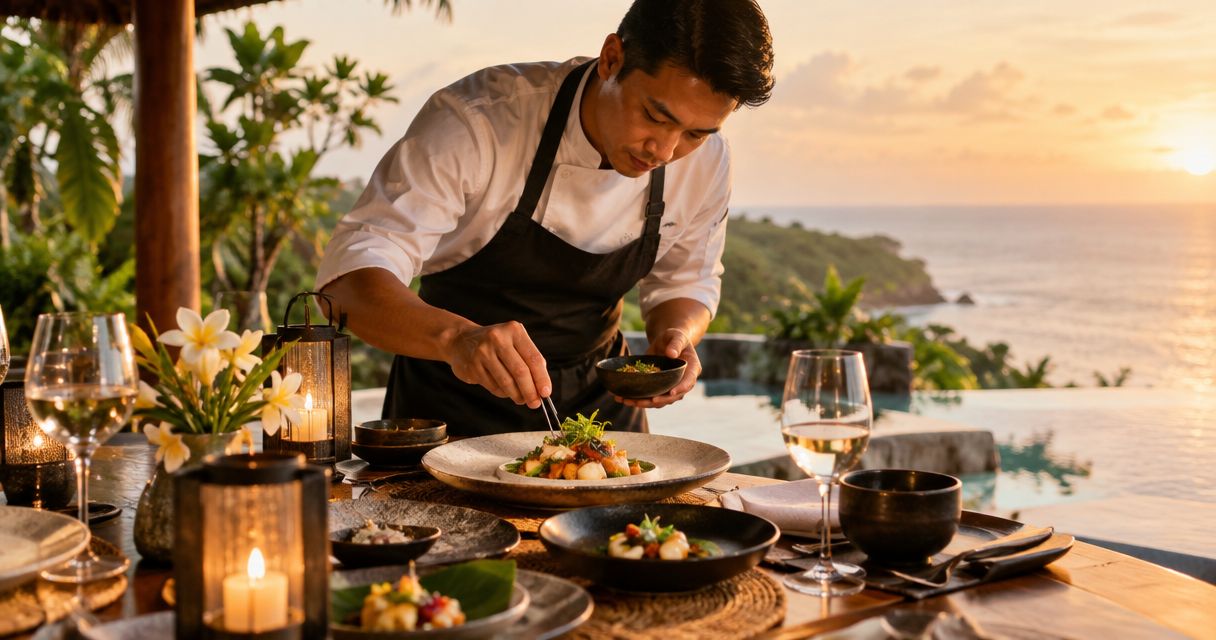
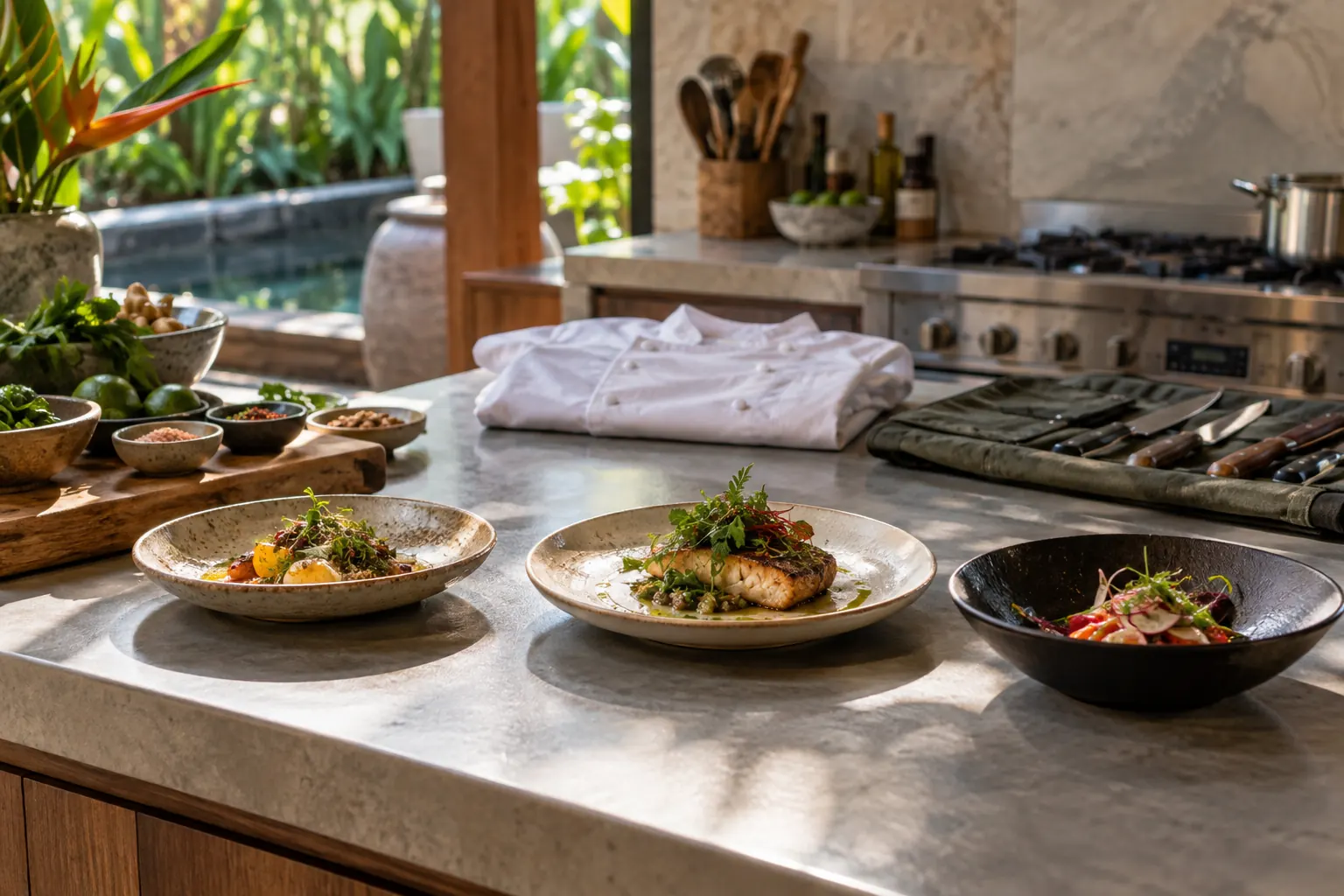
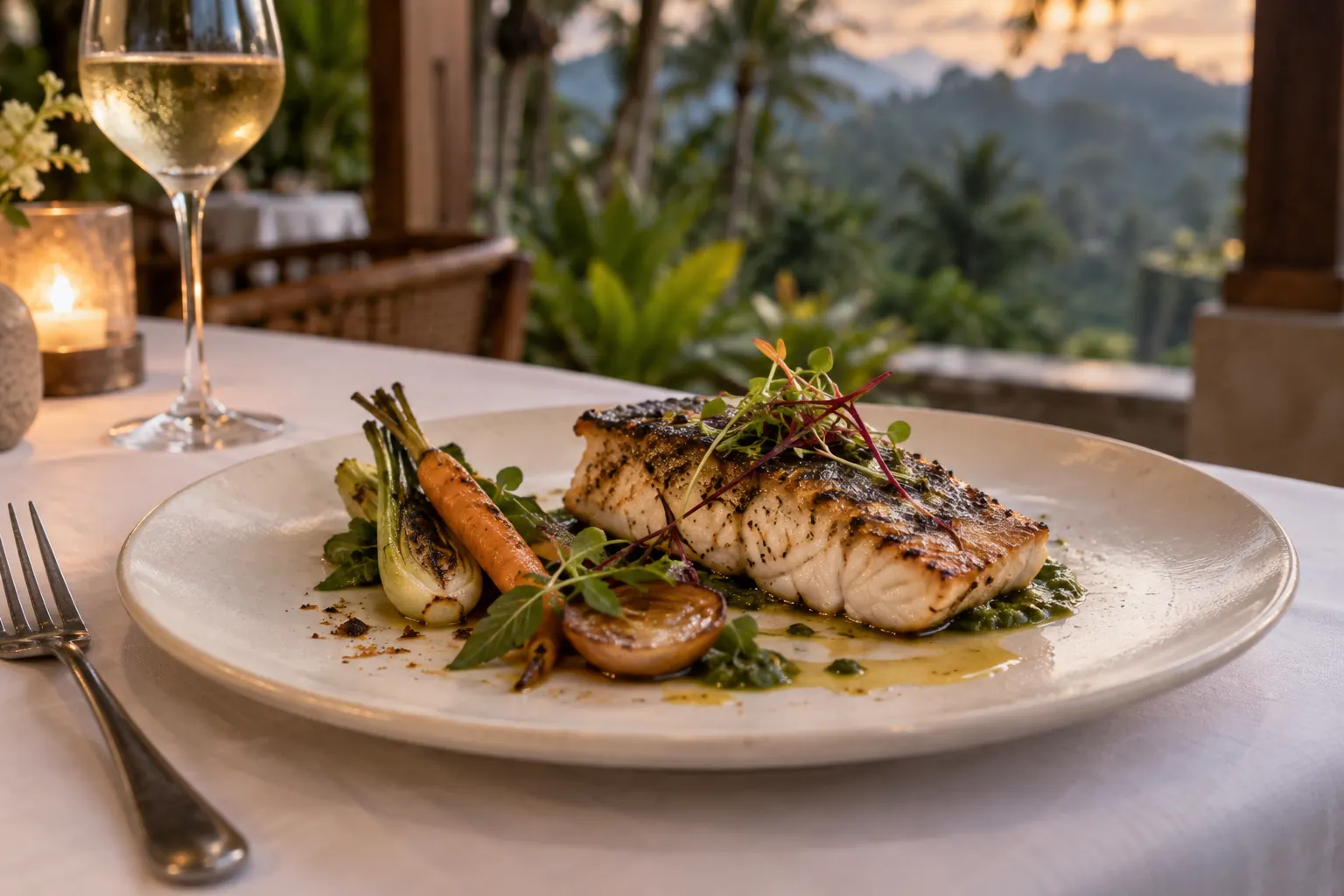
Fine-dining plating is often misunderstood as tiny portions on huge plates. The useful lesson is hierarchy: a main element, supporting textures, a sauce with purpose, and negative space that keeps the eye calm. In a villa setting, plating also has to travel from kitchen to table without collapsing in humidity or wind.
What guests notice without knowing the vocabulary:
- Hot food arrives hot; cold courses arrive properly chilled
- Sauces look intentional, not splashed
- Garnishes are edible and relevant, not decorative clutter
- Every plate at the table lands within a tight window so no one waits while others eat
For multi-course evenings, browse current structures on our tasting menu and fine dining menus pages — then customise for dietary needs and the villa’s kitchen limits.
Sauce discipline: stopped, not finished
In a high-level kitchen you learn that a sauce is never “done” in the abstract — it is stopped at the moment it tastes and coats correctly. Emulsions break when rushed. Reductions turn bitter when ignored. Pasta water is not a meme; it is a tool for viscosity and seasoning.
Villa service makes sauce work more visible. There is no long pass to hide a broken beurre blanc. The practical standard we train toward:
- Sauces held at stable temperature, not constantly reboiled
- Acid and salt adjusted at the end, when the palate is honest
- Texture that clings to protein or pasta instead of pooling
- Consistency across every plate in the course
This is where training shows up as flavour, not as a story on the menu card.
The pasta test
Fresh pasta remains one of the clearest tests of Italian technique: egg quality, dough hydration, rest, roll thickness, cook timing. Many Bali villas have no commercial sheeter. Dough is mixed, rolled and cut by hand, then cooked in small batches so the first plate matches the last.
We source strong local eggs because yolk colour and richness change the dough. Imported “Italian” ingredients are not automatically better; they are sometimes necessary, often not. The standard is the plate, not the passport stamp on the package.
Service standards guests feel immediately
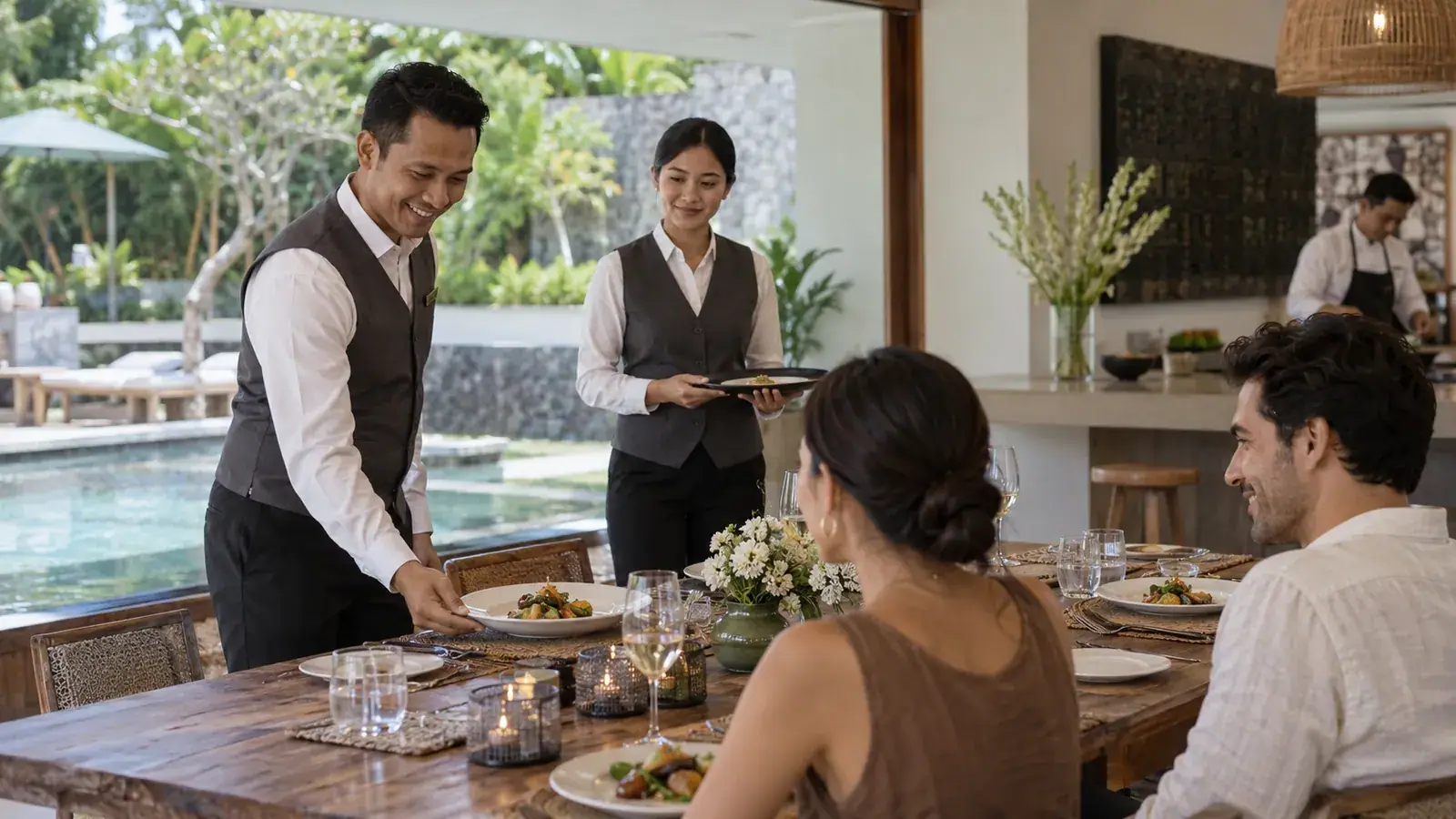
Restaurant training is incomplete without service. Courses need a rhythm. Glasses need refills before they are empty. Dietary notes need to reach the pass without a public conversation at the table. In villas we often pair chefs with waiters or a compact service team from in-villa service so the kitchen can focus on food while the floor protects pace.
What “trained service” looks like on a private estate:
- A short briefing before guests sit — allergies, preferences, pacing, photos
- One lead communicating with the host so requests do not scatter across five people
- Clear course cues (ready when conversation allows, not when the chef is merely bored)
- Quiet reset between courses; no clatter competing with the evening
- Full cleanup so the villa feels like a home again, not a restaurant after-hours
Romantic formats amplify this need for discretion — see romantic dinner and honeymoon chef for couple-focused pacing.
Temperature, timing and the margins you cannot see
Professional cooking lives in small margins: the minute a fish goes dry, the window a steak rests correctly, the second an emulsion tightens. Equipment helps; it does not replace judgement. A modest villa kitchen with a trained chef will outperform an expensive kitchen without one, because the standard is internal.
That is also why menu design must respect villa power and equipment. Technique does not cancel physics. Our logistics mindset — the same discipline used for larger events in the villa wedding catering logistics guide — keeps ambitious menus honest about what the space can support.
How we train and brief the myCHEF team
Adriano’s Milan fine-dining training is a foundation for the brand, not a marketing sticker applied to every plate. Operationally, that means:
- Hiring for discipline and palate, not only for Instagram reels
- Menu briefs that specify texture, temperature and plating notes — not just ingredient lists
- Dietary processes treated as professional constraints
- Feedback loops after service so standards do not drift
When you meet the team on our chefs or explore a chef’s table format, you are booking a system as much as a person: shopping, prep, service and reset under one standard.
What this means when you book
You should expect clear proposals, groceries billed at cost with receipts, and menus that can flex with the season. You should not expect a restaurant star rating transferred onto a villa evening — and you should be wary of any operator who implies otherwise.
What you can expect is the practical residue of fine-dining training: food that tastes deliberate, service that feels calm, and a kitchen left cleaner than it was found. For cost context, read the 2026 private chef cost guide and current figures on pricing.
FAQ — Michelin-style training and villa dining in Bali
Does myCHEF have Michelin stars?
Michelin stars are awarded to restaurants, not to private dining companies. Adriano is fine-dining trained in Milan; that training informs our standards, but it is not the same as a starred restaurant title for myCHEF.
What is the difference between fine-dining training and a good home cook?
Training under pressure builds consistency: seasoning, temperature, sauce work, plating and timing that hold when service is busy. A talented home cook can make excellent food; a trained brigade system aims to make excellent food repeatable.
Can tasting-menu technique work in a normal villa kitchen?
It works with honest menu design. We adapt courses to equipment, power and guest count. Ambition is adjusted to the space so quality stays high rather than theatrical and unstable.
Do we need waiters for a fine-dining villa dinner?
For true multi-course pacing, a compact service team is strongly recommended. Chefs can plate; servers protect timing, glassware and discretion. Smaller dinners can run leaner — we will say so in the quote.
How do we request a Milan-influenced Italian menu in Bali?
Share preferences, dietary needs and guest count. We will design around seasonal produce and technique-led Italian cooking, not a frozen “Tuscan package.” Start via WhatsApp or request a quote.
Want the standard without the restaurant theatrics? Message dates and guest count, or explore tasting menus and private chef dining to begin.